
Professors involved: Virginie Sottile, Nora Bloise, Marco Lolicato
Course learning outcomes/abstract: this course is designed to help PhD students become more effective and efficient in writing scientific communications (abstracts, reports and articles) and grant proposals, by providing them with practical tools, examples, and exercises. By the end of this course, participants will have developed a strong foundation in essential writing skills required for project reporting, manuscript preparation, and grant proposal development. Course Overview Section 1: Scientific abstract preparation Here we focus on what makes an abstract impactful, looking at the structural, stylistic and formatting elements to consider. The subtopics treated will include:
• Abstract writing for conference submission • Abstract writing for scientific manuscript
• Graphical abstracts Section 2: Scientific reporting and manuscript drafting In this section, we focus on the principles and techniques necessary for creating well-organized, clear, and engaging scientific reports and manuscripts.
Subtopics include:
• Introduction to Effective Writing: Overview of principles for clarity, coherence, and conciseness, along with common pitfalls to avoid. • Crafting Strong Sentences and Paragraphs: Strategies for constructing effective sentences and paragraphs that convey complex ideas with simplicity and precision.
• Organizing Content and Streamlining the Writing Process: Practical methods for outlining and structuring papers to enhance readability and simplify the writing process.
• Manuscript Formatting: Understanding the format and components of an original research manuscript, with a focus on crafting the abstract, introduction, methods, results, and discussion.
• Types of Scholarly Articles and the Publication Process: An exploration of the differences between original research papers, reviews, commentaries, and opinion pieces, along with an overview of the publication and peer review process. Disscussion on Predatory journals and unethical publishing.
• Conference Communication: Training on how to create effective posters and talks and communicate scientific findings to lay and scientific audiences, with insights from invited journal editors. Section 3: Project proposal writing The third part of the course transitions to the specific skills required for successful scientific proposal writing.
Subtopics for this section include:
• Differences Between Scientific Papers and Grant Proposals: Key distinctions in style, purpose, and structure, along with tips on adapting writing skills for grant proposals.
• Funding Opportunities and Resources: Insights into local and international fellowship opportunities with guest presentations, e.g., from UniPV and AIRC Grant Offices.
• Structuring a Competitive Proposal: Step-by-step guidance on organizing a compelling proposal, targeting different types of funding schemes.
Goals: this course aims to equip students with the key skills needed to write effectively for academic reports, publications and grant proposals. The course also covers specialized topics like conference abstract drafting, peer review, public science communication, and proposal writing for local and international funding agencies. Through practical exercises and expert guidance, participants will learn the principles of clear and concise scientific writing, including structuring conference abstracts and research manuscripts, including ethical standards in publishing. By the end, participants will be able to craft impactful scientific abstracts, well-organized science papers and structured project outlines
Number of hours and planning: a total of 20 hours
Period: second semester
Calendario: programma delle giornate
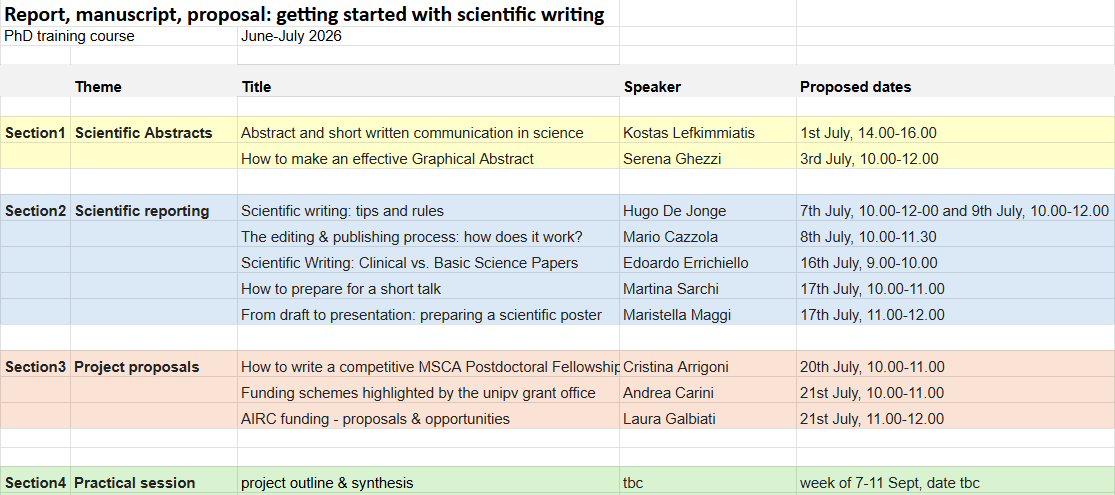
Registration: https://forms.gle/qfKeGGGijm6RLgwf6
Delivery mode and location: the course will be in blended form: some of the lectures will be given online by speakers outside Pavia, while interactive and practice sessions will be carried out in presence
Language: English
Evaluation criterial: a practical and interactive activity, for instance the students will be divided into groups and will work in drafting a scientific abstract or a short project proposal. The students will be evaluated based on their writing skills using metrics such as: (1) Excellent: the students effectively and concisely communicate their ideas; (2) Good: the students are able to transmit their scientific ideas, however the communication skills can be improved; (3) Sufficient: the students can share their ideas, however, the communication style lacks precision, concision or scientific specificity; (4) Poor: the students are not able to efficiently communicate their ideas.
Credits (CFU): 5
Search
- Bandi di concorso
- Certificati
- Corsi trasversali
- Domande frequenti (FAQ)
- Fonti normative
- Informazioni dottorandi
- Informazioni coordinatori
- Intensive School for Advanced Graduate Studies (ISAGS)
- Internazionalizzazione
- MSCA-DN@UNIPV
- Opportunità per imprese e finanziatori
- Protezione dei dati personali
- Riconoscimento accademico dei titoli di dottorato di ricerca conseguiti all’estero
- Scuola di Alta Formazione Dottorale (SAFD)
- Trasparenza